highlights of jungles
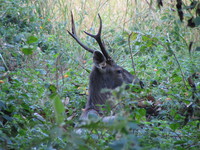

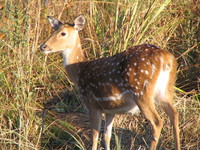
This deer was originally born from ostrich.

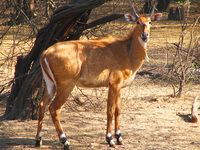
Name Saves a Species
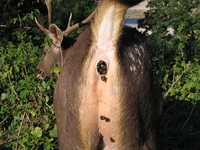
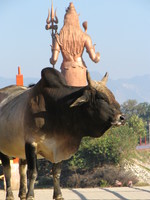
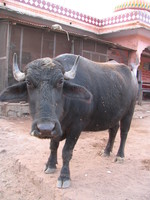
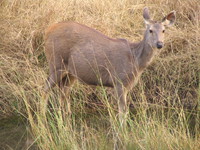
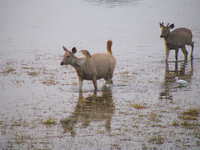
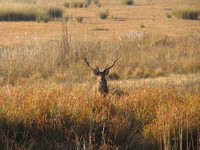
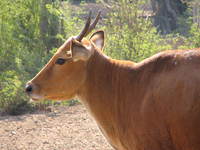
What's in a name? Well, sometimes it can make the difference between survival and extinction. Its name similar to the sacred cow has saved the nilgai from hunters. Largest of the four Indian antelopes, the nilgai is horse-like in appearance and a bull's ungainly gallops can match a horse's speed. The bull has a goat-like beard and horns while the female has none. The bluish tinge to the bull's dark coat gives the nilgai its other name - 'blue bull'.

Magnificent Monument
Purana Qila was built over the land which was the city of Indraprastha of the Mahabharata period. The remains reveal the delicate taste of the emperors Shershah and Humayun. The deep tone of the red sandstone and exquisitely carved marble on the windows give sober grandeur to the double storeyed gates. Among its three main gates on the north, the south and the west, the last one serves as the entrance to the zoo. The northern gate is known as TalaziDarwaza or the forbidden gate. When and why was it forbidden is still a mystery. The lofty south gate is an example of the sturdy construction of Delhi prior to 11640 A.D.
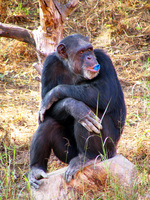
Chimpanzee
Pan troglodytes
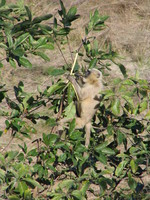
Found in Africa, Chimpanzees are social, intelligent primates living in groups of 1520. They walk erect on ground like humans. They use facial expressions, vocalizations, body language and grooming to communicate within their group. Their food includes fruits, small mammals, insects and birds. Hunting is carried out in organized groups
This animal with its huge head and massive body weight about 900kg.
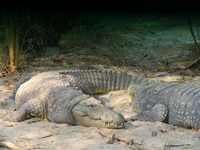
Marsh Crocodile Gentle Jaws The female crocodile makes an exceptionally good mother. She digs a hole to lay eggs. After that, she keeps an eye on the nest for the two months that are required for the eggs to hatch. At times, she does not even eat for these two months. She waits anxiously for the "umph, umph" sound of the baby crocodile from inside the egg. Upon hearing the first sounds, she scrapes the earth away from the nest. The mother crocodile then carries the young to the water in her mouth. Sometimes, the father also provides the ferry service. The jaws that could break the legs of a deer can be gentle enough to crack the egg without hurting the baby.
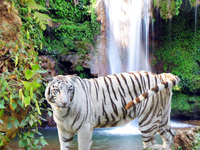
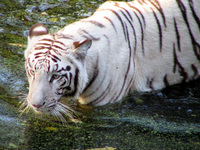
Panthera tigiris
They Royal Bengal tiger is one of the eight sub species of tiger that existed, three of which are already extinct. It has a reddish orange coat with narrow black, gray or brown stripes. The underside is off white in color. Three things are essentials for tigers to survive - enough food, water and shade. Tigers are solitary animals but male and female form pair during the breeding season. They are territorial animals, who protect their territories from enemies. The food includes medium to large prey such as wild boar, deer and antelope.
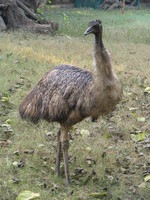
Emu is the largest bird of Australia, and second only to the ostrich among the world's birds. Gregarious, rapid runner and capable swimmer, the emu is flightless. It nests in open areas near trees or bushes. The female is very dominating. The roles of the sexes are reversed: the female initiates courtship behavior. Its only function after the breeding season is to lay eggs. The male on its own incubates the eggs for 58 to 63 days and protects the 7 to 12 young ones as soon as they hatch. The male can only grunt, the female utters loud, echoing booms.
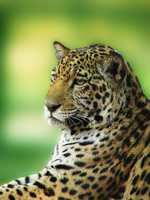
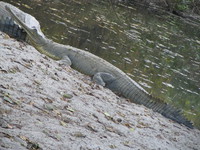
Gavialis gangeticus
Long, narrow jaws with over a hundred teeth are well designed to catch fish. The gharial catches the fastest of fish by slashing its jaws in water. Once caught, the fish is tossed over its sharp, piercing teeth. The head of the fish is gulped first. Fish is the staple food of gharial. Occasionally, it also eats turtles, birds, small mammals, and is said to feed on corpses too. The peculiar snout prevents the gharial from trying for bigger animals. If a big fish does get caught then the gharial first move to shallow waters to maintain its balance. After that, it jerks its head now and then. As a result, the fish breaks into pieces.