delhi zoo
Delhi zoo is closed on Friday
Every zoo is just an animal prison. The New Delhi Zoo is a better prison than others. It is generally clean, very relaxing place to spend a full day. The entrance price is only 50 Rupees, including the map, which is an exceptionally good deal (I paid 750R for Taj Mahal and I didn't even get a f-ing piece of paper).

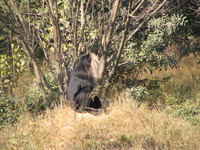
The lion tailed macaque is found in the tropical evergreen forests of Southern India. It has black-gray coat. Its face is surrounded by a ruff of hair resembling a lion's mane. The tail too has a slight tuft at the tip. Lion-tailed macaques live in troops of varying size, usually 10 - 20 individuals with up to three mature males. They are arboreal in nature and feed primarily on fruits. Leaves, seeds, eggs and insects are some of the other items relished by them.
Facts: Height: 50-60cm Weight: 6.5 - 15 kg; Lifespan: 20 - 30 years, Adulthood 4 years (female) / 8 years (Male); Gestation period: 5.5 months
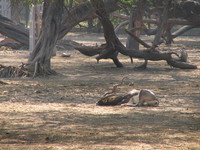
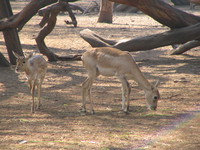
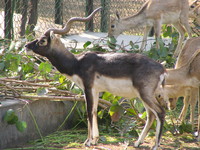
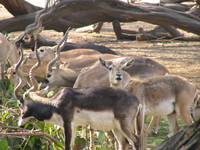
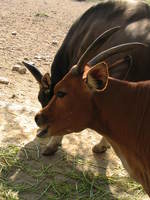
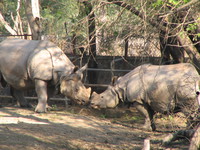
This animal with its huge head and massive body weight about 900kg.
The distinctive horn on its snout is not a true horn. It has neither a bony core nor is it connected to the skull. It is millions of compact hair-like fibres growing from the snout. Like our nails, the horn contains keratin and continues to grow every year. If broken, it is replaced. For centuries, the rhino horn has been used to make cups, bowls, daggers, bows and arrows, decorative carvings, sword hilts, walking sticks, door handles, the list is endless. The false beliefs that the horn is an aphrodisiac have left the rhino at man's mercy.
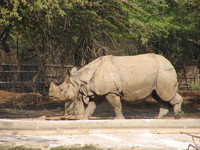
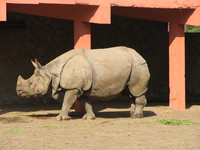
The distinctive horn on its snout is not a true horn. It has neither a bony core nor is it connected to the skull. It is millions of compact hair-like fibers growing from the snout. Like our nails, the horn contains keratin and continues to grow every year. If broken, it is replaced. For centuries, the rhino horn has been used to make cups, bowls, daggers, bows and arrows, decorative carvings, sword hilts, walking sticks, door handles, the list is endless. The false beliefs that the horn is an aphrodisiac have left the rhino at man's mercy.
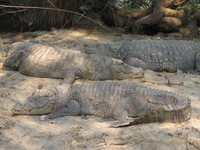
Marsh Crocodile Gentle Jaws The female crocodile makes an exceptionally good mother. She digs a hole to lay eggs. After that, she keeps an eye on the nest for the two months that are required for the eggs to hatch. At times, she does not even eat for these two months. She waits anxiously for the "umph, umph" sound of the baby crocodile from inside the egg. Upon hearing the first sounds, she scrapes the earth away from the nest. The mother crocodile then carries the young to the water in her mouth. Sometimes, the father also provides the ferry service. The jaws that could break the legs of a deer can be gentle enough to crack the egg without hurting the baby.
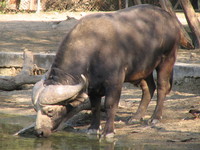
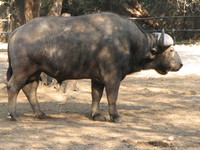
Cape Buffalo African resident The horns of a cape buffalo are magnificent and distinctly curved. They spread outwards from the base, curve downwards and then upwards again. Feamles ahve narrower horns. The cape buffalo's habitat ranges from dense forests to plains and mountains. It lives in small herds of three or four individuals in forested regions in open plains it can be found in large congregations. Wherever it lives, the cape buffalo won't be far from water supply. It needs to drink daily and loves to wallow in the mud.
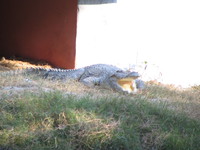
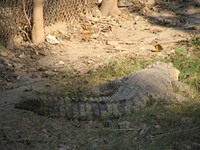
Spectacled Caiman
Caiman crocodilus
Found in South and Central America, they get their name from the bony ridges that look like a pair of eyeglasses around the eyes. They prefer still water but also live in lowland wetlands, rivers, and seasonally flooded savannas. They are good swimmers and are nocturnal in nature. Food consists of fish, birds, turtles, reptiles and mammals which are swallowed whole. Females build a large soil-and-vegetation mound nest in which eggs are laid.
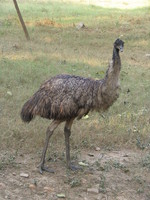
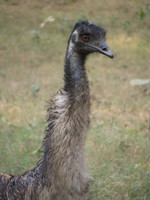
Emu is the largest bird of Australia, and second only to the ostrich among the world's birds. Gregarious, rapid runner and capable swimmer, the emu is flightless. It nests in open areas near trees or bushes. The female is very dominating. The roles of the sexes are reversed: the female initiates courtship behavior. Its only function after the breeding season is to lay eggs. The male on its own incubates the eggs for 58 to 63 days and protects the 7 to 12 young ones as soon as they hatch. The male can only grunt, the female utters loud, echoing booms.
Emu is the largest bird of Australia, and second only to the ostrich among the world's birds. Gregarious, rapid runner and capable swimmer, the emu is flightless. It nests in open areas near trees or bushes. The female is very dominating. The roles of the sexes are reversed: the female initiates courtship behavior. Its only function after the breeding season is to lay eggs. The male on its own incubates the eggs for 58 to 63 days and protects the 7 to 12 young ones as soon as they hatch. The male can only grunt, the female utters loud, echoing booms.
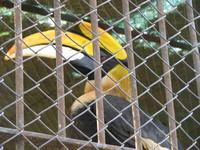
Hornbills are a large family of almost 45 species. This omnivorous bird has a long, curved bill. Before laying eggs the female sits in a hole in a tree trunk. The male and the female, from within, then seal the cavity leaving a slit wide enough for the tip of the female's bill to come out. The male feeds the female until the young are half grown -a minimum of 5 weeks, and for some species nearly 3 months.
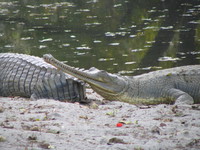
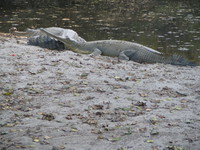
Gavialis gangeticus
Long, narrow jaws with over a hundred teeth are well designed to catch fish. The gharial catches the fastest of fish by slashing its jaws in water. Once caught, the fish is tossed over its sharp, piercing teeth. The head of the fish is gulped first. Fish is the staple food of gharial. Occasionally, it also eats turtles, birds, small mammals, and is said to feed on corpses too. The peculiar snout prevents the gharial from trying for bigger animals. If a big fish does get caught then the gharial first move to shallow waters to maintain its balance. After that, it jerks its head now and then. As a result, the fish breaks into pieces.
Gavialis gangeticus
Long, narrow jaws with over a hundred teeth are well designed to catch fish. The gharial catches the fastest of fish by slashing its jaws in water. Once caught, the fish is tossed over its sharp, piercing teeth. The head of the fish is gulped first. Fish is the staple food of gharial. Occasionally, it also eats turtles, birds, small mammals, and is said to feed on corpses too. The peculiar snout prevents the gharial from trying for bigger animals. If a big fish does get caught then the gharial first move to shallow waters to maintain its balance. After that, it jerks its head now and then. As a result, the fish breaks into pieces.
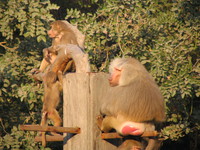
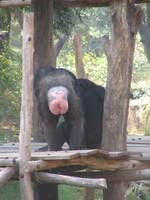
A large head with a bright pink face might give this baboon a disagreeable appearance. But the Egyptians think otherwise. Long had the hamadrayas baboon has been revered in Egypt. It was dedicated to God Thoth. It has found place in the paintings in countless monuments and tombs. Many baboon mummies have also been discovered.
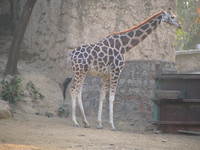
Tallest living quadruped; having a spotted coat and small horns and very long neck and legs; of savannahs of tropical Africa